
What Is a Hall Effect Joystick? TMR Guide
A Hall effect joystick uses a magnet and contactless sensor to track thumbstick angle without carbon-track wear—here is how it compares with ALPS and TMR sticks.
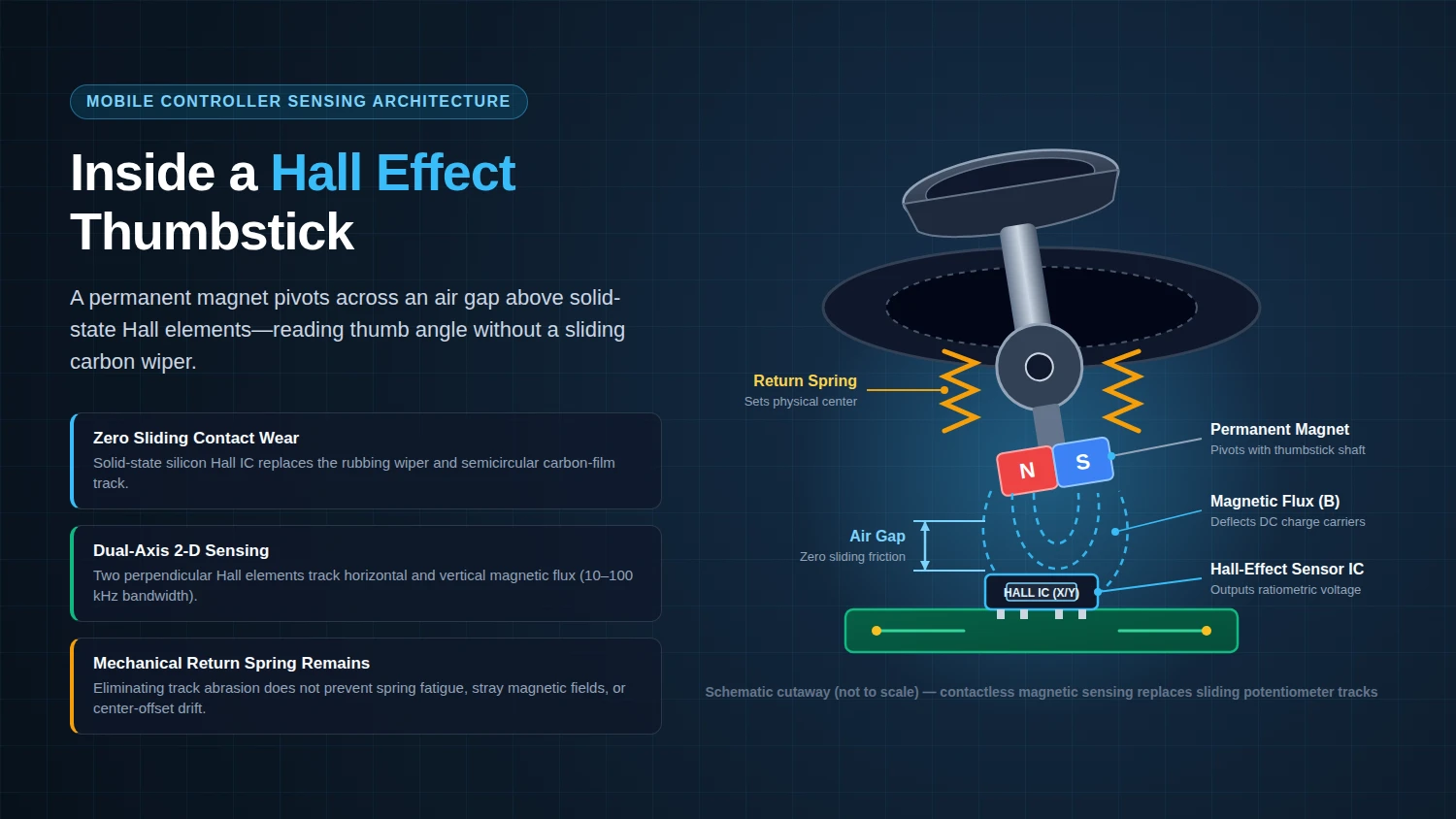
Schematic cutaway (not to scale): a permanent magnet pivots across an air gap above a dual-axis Hall-effect sensor IC, eliminating sliding contact wear while keeping a mechanical return spring.
A Hall effect joystick uses a permanent magnet and solid-state magnetic sensor to track thumbstick position across an air gap instead of sliding a metal wiper over a carbon track. By removing physical contact inside the position sensor, it prevents abrasive potentiometer wear—though centering accuracy still relies on the mechanical return spring and calibration.
Before picking a gamepad for your phone, pair stick-sensor longevity with connection path and physical clearance. Our guide comparing USB-C versus Bluetooth mobile gaming controllers for Android covers port seating, game support, and clip-on cooler fit, while this explainer focuses on the thumbstick sensing hardware inside the controller.
What is the Hall effect inside a controller sensor?
Inside a controller sensor, the Hall effect generates a transverse voltage across a current-carrying conductor whenever a perpendicular magnetic field deflects charge carriers via the Lorentz force, as documented by NIST. Discovered by Edwin Hall in 1879, this solid-state principle reads thumbstick tilt through magnetic flux changes with zero mechanical contact.
How Lorentz deflection turns stick tilt into a 2-D signal
In a Hall-effect sensor, a fixed direct-current bias flows along one axis of a thin conductive strip called the Hall element transducer. When you tilt the thumbstick, an attached permanent magnet shifts its magnetic field across that strip, and the sensor sends position values to the controller microcontroller—the same contactless sensing loop analyzed in microcontroller Hall-array research (See and Abd-Alhameed, Sensors). The Lorentz force curves the path of moving charge carriers toward one edge of the element, building an asymmetric charge separation and a steady transverse Hall voltage while current flows. That voltage scales with the material’s Hall coefficient, the bias current, and the perpendicular magnetic field strength, and inversely with element thickness.
Because a single Hall element senses only one axial component of magnetic flux, reading full two-dimensional thumbstick travel requires two perpendicularly oriented Hall elements—one for horizontal motion and one for vertical motion. Hall-effect elements respond to both changing magnetic fields and static fields, so the sensor holds a steady reading even when you keep the stick tilted at a constant angle.
Ratiometric outputs, amplification, and bandwidth
Bare Hall elements output a very low voltage, so modern commercial Hall sensors integrate the sensing element and a high-gain integrated-circuit amplifier inside one package—leveraging the design simplicity, low cost, and integrated-circuit fabrication compatibility highlighted in planar Hall sensor research (Klein et al., Sensors). Linear Hall sensors output an analog voltage, pulse-width modulation signal, or digital bus signal proportional to incident magnetic field strength.
Many joystick designs use ratiometric linear sensors whose sensitivity tracks the controller supply voltage and whose quiescent output sits at half of the supply voltage when no net magnetic field is applied. As ETI Systems notes in its Hall joystick engineering guidance, referencing a ratiometric output to the same supply rail as the controller’s analog-to-digital converter keeps position scaling stable even when battery voltage sags slightly under load. Commercial silicon Hall-effect sensors commonly provide 10 to 100 kHz of measurement bandwidth, far faster than human thumb movement.
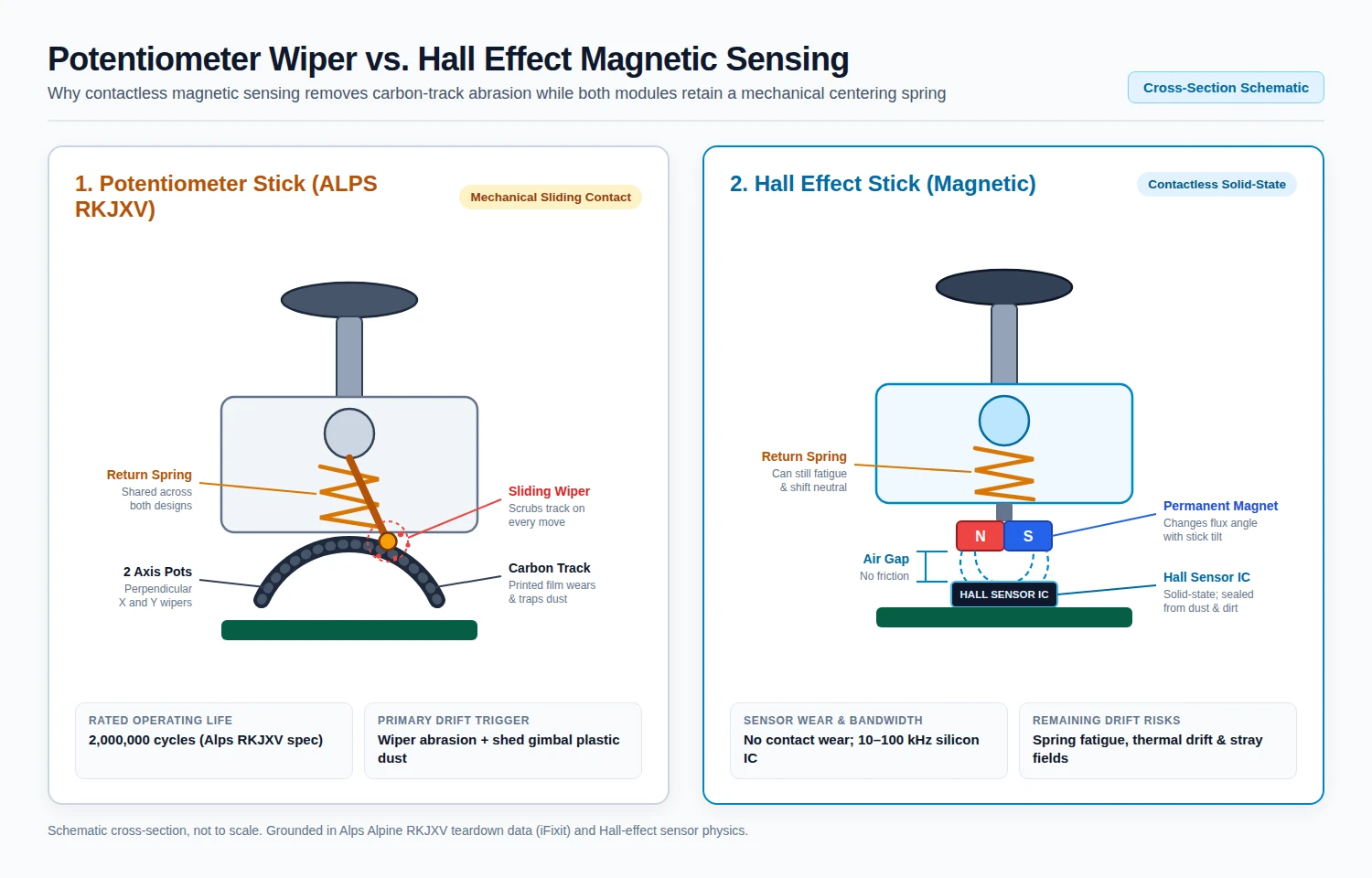
How does a Hall effect joystick differ from a potentiometer or ALPS module?
A Hall effect joystick senses thumbstick tilt magnetically across an air gap, whereas a traditional potentiometer stick—such as the Alps Alpine RKJXV analog module—uses rotating metal wipers that physically scrub semicircular printed carbon-film tracks. Removing that sliding contact eliminates carbon-track abrasion and dust contamination inside the position sensor itself.
Inside ALPS RKJXV potentiometer wear and cycle math
Conventional analog sticks rely on two perpendicular potentiometers per thumbstick: one reading up-and-down movement and one reading left-and-right movement. According to iFixit’s DualSense teardown analysis, Alps Alpine’s RKJXV series modules appear across PlayStation, Xbox, and Nintendo Switch Pro controllers and list a potentiometer operating life of 2,000,000 cycles on the manufacturer specification sheet.
Back-of-the-envelope cycle math from iFixit’s teardown team shows how quickly active play reaches that rated ceiling:
- Moderate stick activity (80 full rotations per minute): Reaching 2,000,000 rotations takes 25,000 minutes, or 417 hours—equal to 209 days at 2 hours of play per day.
- High-intensity stick activity (120 full rotations per minute): Reaching 2,000,000 rotations takes 139 days at 2 hours of play per day.
Hitting 2,000,000 cycles does not mean a potentiometer automatically fails on day 209, nor does it prevent earlier drift. Every movement drags the metal wiper across the carbon resistive strip, gradually carving surface imperfections that alter voltage readings. Compounding that wear, modern joystick gimbals rely on self-lubricating plastics that shed microscopic wear dust during friction. Inside an open potentiometer housing, accumulated debris degrades electrical contact, whereas properly packaged solid-state Hall-effect sensors are immune to mechanical contact wear as well as dust, dirt, mud, and water.
Potentiometer vs. Hall effect vs. TMR thumbsticks at a glance
Scroll horizontally to see all columns.
| Technical attribute | Potentiometer (e.g. ALPS RKJXV) | Hall effect joystick | TMR thumbstick |
|---|---|---|---|
| Physical sensing mechanism | Two perpendicular rotating wipers scrubbing printed carbon-film tracks | Two perpendicular solid-state Hall elements reading magnetic flux across an air gap | Nanometer-scale magnetic tunnel junction (free layer, insulator barrier, reference layer) varying resistance |
| Primary electrical output | Variable voltage across resistive carbon track | Linear analog voltage, PWM, or digital bus (may be ratiometric at half supply at zero field) | Resistance shift driven by spin-dependent quantum electron tunneling |
| Sliding sensor contact wear | Yes; Alps RKJXV potentiometer rated for 2,000,000 cycles | None inside the solid-state sensor IC | None inside the solid-state magnetic tunnel junction |
| Contamination resistance | Vulnerable to shed plastic dust, dirt, and surface grime | Sealed Hall IC packages resist dust, dirt, mud, and water | Sealed thin-film solid-state sensor avoids open wiper contamination |
| Published sensor benchmark | 417 hours (209 days at 2 hours/day) at 80 rotations/minute in iFixit cycle model | 10 to 100 kHz commercial silicon bandwidth; ~400 micrometer rigid silicon die thickness | Hundreds of percent room-temperature MgO TMR ratio (up to 604% observed) |
| Remaining drift or offset factors | Carbon abrasion, debris, return-spring fatigue, factory resistance variance | Return-spring fatigue, thermal drift, lifetime sensor drift, stray magnetic fields | Return-spring fatigue, mechanical gimbal wear, calibration and external field layout |
What is the difference between Hall effect and TMR thumbsticks?
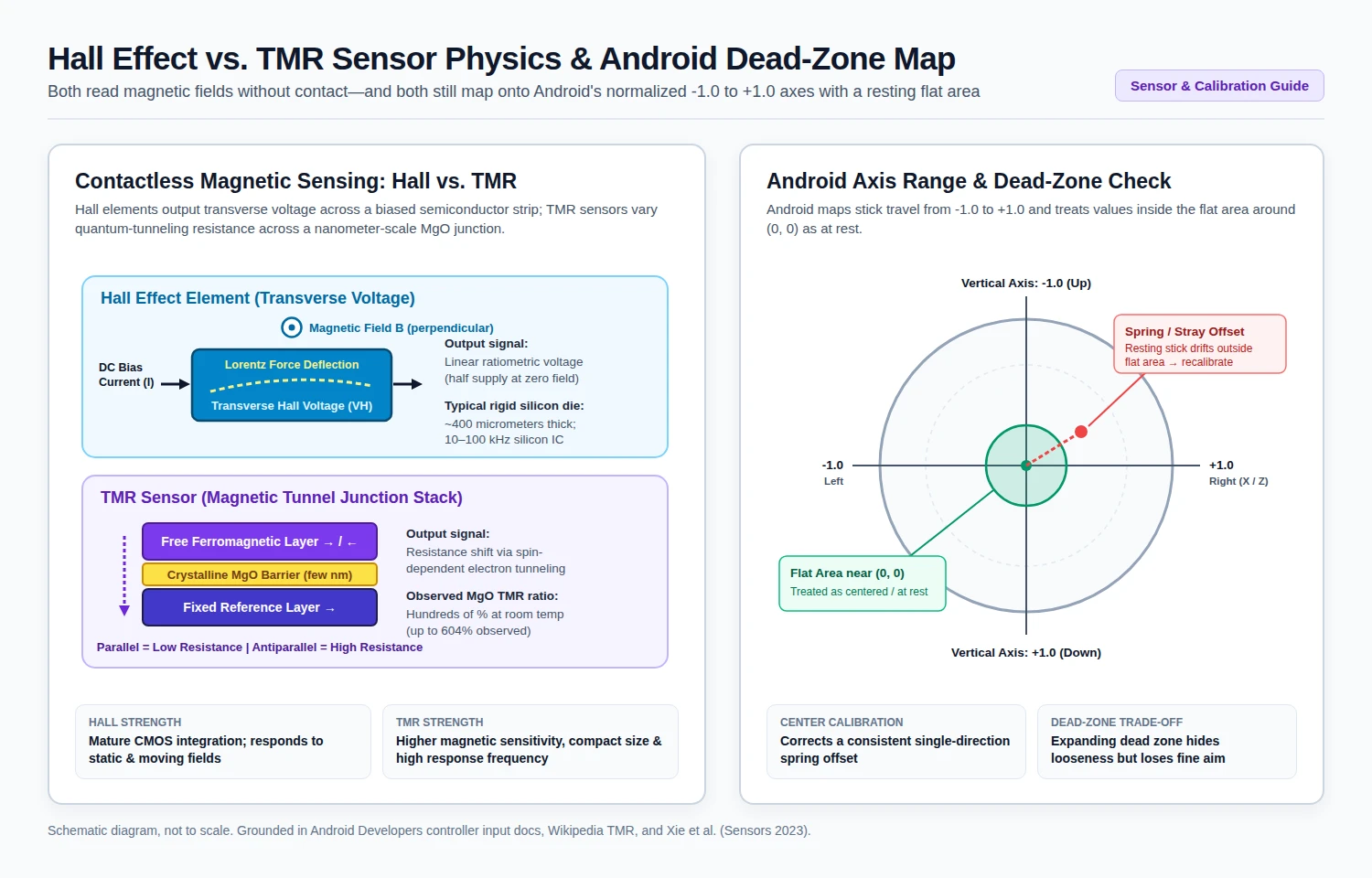
Both Hall effect and Tunnel Magnetoresistance (TMR) thumbsticks use contactless magnetic sensing to avoid carbon-track wear, but they measure different physical phenomena. A Hall sensor measures transverse voltage induced across a DC-biased semiconductor strip, whereas a tunnel magnetoresistance sensor measures quantum-tunneling electrical resistance across an ultrathin magnetic tunnel junction.
How a magnetic tunnel junction reads thumbstick angle
Discovered by Michel Jullière in 1975 with a 14% relative resistance change at 4.2 K, TMR takes place inside a magnetic tunnel junction composed of two ferromagnetic layers separated by an insulating barrier only a few nanometres thick. In a peer-reviewed Sensors review of magnetic sensors (Xie et al.), the authors describe the sensing stack as a fixed reference layer, a thin barrier layer, and a free ferromagnetic layer whose magnetization rotates in response to an external magnetic field.
When the free and reference magnetizations point in parallel directions, electrons tunnel more readily across the insulating barrier and junction resistance drops to its minimum. When the magnetizations align antiparallel, tunneling decreases and resistance rises to its maximum. Early room-temperature junctions using amorphous aluminum oxide barriers yielded TMR ratios in the tens of percent, whereas epitaxial crystalline magnesium oxide (MgO) barriers boosted room-temperature TMR into the hundreds of percent—with the largest observed ratio reaching 604%.
Why controller makers are adopting TMR alongside Hall sensors
Compared with anisotropic and giant magnetoresistive sensors, peer-reviewed sensor literature highlights TMR devices for higher magnetic field sensitivity, compact size, and high response frequency. Readout-circuit research in Micromachines (Sun et al.) likewise notes that TMR sensors combine high sensitivity, low power consumption, wide dynamic range, temperature stability, and CMOS compatibility—while requiring precision signal conditioning because typical TMR Wheatstone-bridge outputs are weak and subject to process mismatch, DC offset, thermal noise, and low-frequency flicker noise. Because traditional rigid semiconductor Hall sensor dies measure roughly 400 micrometers thick and rely on amplifying a low transverse Hall voltage, thin-film MTJ-based TMR position sensors are increasingly replacing Hall sensors across consumer, automotive, and industrial hardware for stronger signal performance.
For mobile Android gamers, both Hall effect and TMR eliminate sliding potentiometer abrasion. Neither architecture guarantees superior in-game aiming on its own, however: actual control feel still depends on the mechanical gimbal, spring tension, ADC conversion, and firmware calibration curve.
Does a Hall effect joystick feel different from a regular stick?
Most of the physical tension and snap-back you feel under your thumb comes from the gimbal housing and centering spring rather than the magnetic sensor itself. Because a Hall effect module omits sliding wiper friction and produces a steady signal across slow micro-movements near neutral, it can feel smoother during fine aiming without necessarily feeling stiffer or looser.
Shared mechanics and a three-decade history
Hall-effect analog sticks are not a recent invention. Sega shipped magnet-based Hall-effect sensors inside the Saturn 3D control pad on July 5, 1996, carried the design into the Sega Dreamcast controller, and watched the technology return in the 2020s as gamers demanded longer-lasting alternatives to potentiometer modules.
Even so, a modern magnetic thumbstick still contains the same core mechanical parts identified in iFixit’s controller teardown: a centering return spring that pulls the shaft back to neutral when you release your thumb, plus a tactile push-in button switch underneath the stick. ETI Systems’ joystick engineering guidance emphasizes that operator confidence during slow alignment depends on three coupled behaviors: center repeatability, smooth non-stepping output during slow travel near neutral, and stable tracking across temperature changes. If a controller pairs great Hall or TMR chips with a sloppy plastic gimbal or weak return spring, the stick will still feel loose in your hands.
Do Hall effect mobile controllers still need deadzone calibration on Android?
Yes—contactless magnetic sensors eliminate carbon-track wear, but Hall effect mobile controllers can still drift off center and need calibration. Return-spring fatigue, sensor thermal and lifetime drift, and stray external magnetic fields can all move the resting position away from true zero, requiring center recalibration or an appropriate Android dead zone.
Why contactless sticks can still lose center
An analog stick only works cleanly when its resting state matches the neutral coordinate that the controller interprets as zero movement. If the resting signal shifts away from that established neutral point, the game receives phantom movement even when your thumb is off the stick. Three hardware mechanisms can still cause off-center readings on Hall effect controllers:
- Return-spring fatigue: As iFixit notes, repeated gaming cycles can stretch the self-centering spring slightly, creating a new physical resting point. The magnetic sensor reads that shifted angle accurately, yet the character or camera still drifts because the spring no longer returns the shaft to true center.
- Thermal and lifetime sensor drift: Solid-state Hall sensors remain susceptible to thermal drift as operating temperatures change and to gradual time drift over the lifetime of the sensor.
- Stray external magnetic fields: Ambient magnetic flux from nearby wiring, magnets, or surrounding hardware can enhance or diminish the field reaching a single Hall element. Designers mitigate this with magnetic shielding or differential dual-element Hall layouts that cancel common-mode stray fields, yet keeping strong external magnets away from the thumbstick housing remains good practice.
How Android reads stick axes and the flat area
Android Developers’ controller input documentation specifies that Android reports analog stick movement through motion events normalized from -1 to 1 (and analog triggers from 0 to 1), mapping the left stick to dedicated horizontal and vertical motion axes and the right stick to a separate dual-axis pair. During rapid movement, Android batches multiple historical axis samples inside move events so games can render smooth motion paths.
Crucially, Android joysticks define a flat area—a small range of values surrounding the (0, 0) origin that games treat as centered and motionless. Software center calibration can compensate for a consistent, one-directional shift caused by a fatigued return spring. By contrast, widening the software dead zone masks general mechanical looseness by ignoring small movements near center—but pushing the dead zone too wide destroys fine micro-aiming control.
Mobile controller joystick sensor and dead-zone verification checklist
Before keeping a new Hall effect or TMR mobile controller—or when troubleshooting off-center aim—run this commissioning check grounded in ETI Systems’ baseline sweep procedure and Android’s input behavior, and record your phone model alongside our Android device compatibility checklist:
Scroll horizontally to see all columns.
| Verification step | What to test on your Android controller | Pass sign vs. red flag |
|---|---|---|
| 1. Full-travel baseline sweep | Move each stick from resting center to full edge travel in all directions, release cleanly, and repeat across several cycles | Stick returns consistently to the same neutral coordinates without hanging outside the resting flat area |
| 2. Slow-travel micro-input check | Tilt each stick slowly just past center while watching a live input visualizer or in-game aim reticle | Smooth continuous ramp from 0 toward full travel rather than sudden stepping or center jitter |
| 3. Center calibration vs. dead zone | Run the controller’s built-in center calibration first if you notice a steady one-directional resting offset | Steady one-way spring bias clears after calibration; needing a wide dead zone signals mechanical looseness |
| 4. Stray magnetic field isolation | Test resting center with and without magnetic phone cases, mounting rings, or simultaneous magnetic trigger pulls | Neutral reading stays steady; a shift during trigger press or case attachment indicates magnetic interference |
For broader gear decisions—from hubs and cables to open-ear headsets and car mounts—browse our complete Android accessories guide.
Frequently asked questions
Does a Hall effect joystick completely eliminate stick drift?
No. A Hall effect joystick avoids drift caused by wiper abrasion and dust fouling on a carbon potentiometer track, because its magnet and solid-state sensor read position across an air gap without sliding electrical contact. However, return-spring fatigue, plastic gimbal looseness, thermal sensor drift, or nearby stray magnetic fields can still shift the stick’s resting neutral point and require recalibration.
How long does an ALPS potentiometer stick last compared with a Hall effect stick?
Alps Alpine’s RKJXV potentiometer specification sheet lists an operating life of 2,000,000 cycles, which iFixit’s teardown calculation translates to 417 hours (209 days at 2 hours/day) at 80 rotations per minute, or 139 days at 2 hours/day at 120 rotations per minute. Because solid-state Hall-effect sensors have no sliding electrical contacts, their sensing elements are not lifespan-limited by mechanical wiper wear, leaving the mechanical return spring and push-in switch as the primary wear items.
Are TMR thumbsticks better than Hall effect thumbsticks?
Both TMR and Hall effect sticks provide contactless magnetic sensing that prevents potentiometer track wear. Peer-reviewed Sensors literature shows that crystalline MgO magnetic tunnel junction (TMR) sensors deliver higher magnetic field sensitivity, compact size, and high response frequency compared with older magnetoresistive technologies, and MTJ position sensors are replacing Hall sensors across many modern applications. In a mobile controller, real-world precision still depends equally on gimbal tolerances, spring centering, and firmware calibration.
Why does my Hall effect controller have a dead zone on Android?
Android represents analog stick travel on normalized -1 to 1 axes and defines a small flat area around the (0, 0) center coordinate so minor resting tolerances are treated as motionless. A tight dead zone prevents unwanted camera creep from tiny spring-centering variations, whereas expanding the dead zone excessively hides mechanical looseness at the expense of fine aiming control.
Can magnetic phone cases or Hall triggers interfere with Hall effect thumbsticks?
Potentially. Single-element Hall sensors are sensitive to stray external magnetic flux from surrounding wiring or nearby magnets, which can distort resting or travel readings if the sensor lacks magnetic shielding or a differential dual-element layout. Checking resting neutral coordinates both with and without magnetic phone accessories—and while pulling analog triggers—quickly reveals whether stray fields affect your controller.
Sources
- National Institute of Standards and Technology (NIST) — The Hall Effect and the Lorentz Force
- Xie, Yang, and Shang et al. — Flexible Magnetic Sensors, Sensors
- Sun et al. — A Low-Power Chopper-Stabilized Readout Interface ASIC for High-Resolution TMR Magnetometers, Micromachines
- Klein et al. — Planar Hall Effect Magnetic Sensors with Extended Field Range, Sensors
- See and Abd-Alhameed — Position Detection Using Hall-Effect Sensor Arrays on Resource-Constrained Microcontroller, Sensors
- iFixit — Here’s Why PS5 Joysticks Drift (Alps Alpine RKJXV teardown)
- ETI Systems — Hall Effect Joystick Guide
- Android Developers — Handle Controller Actions
Related articles
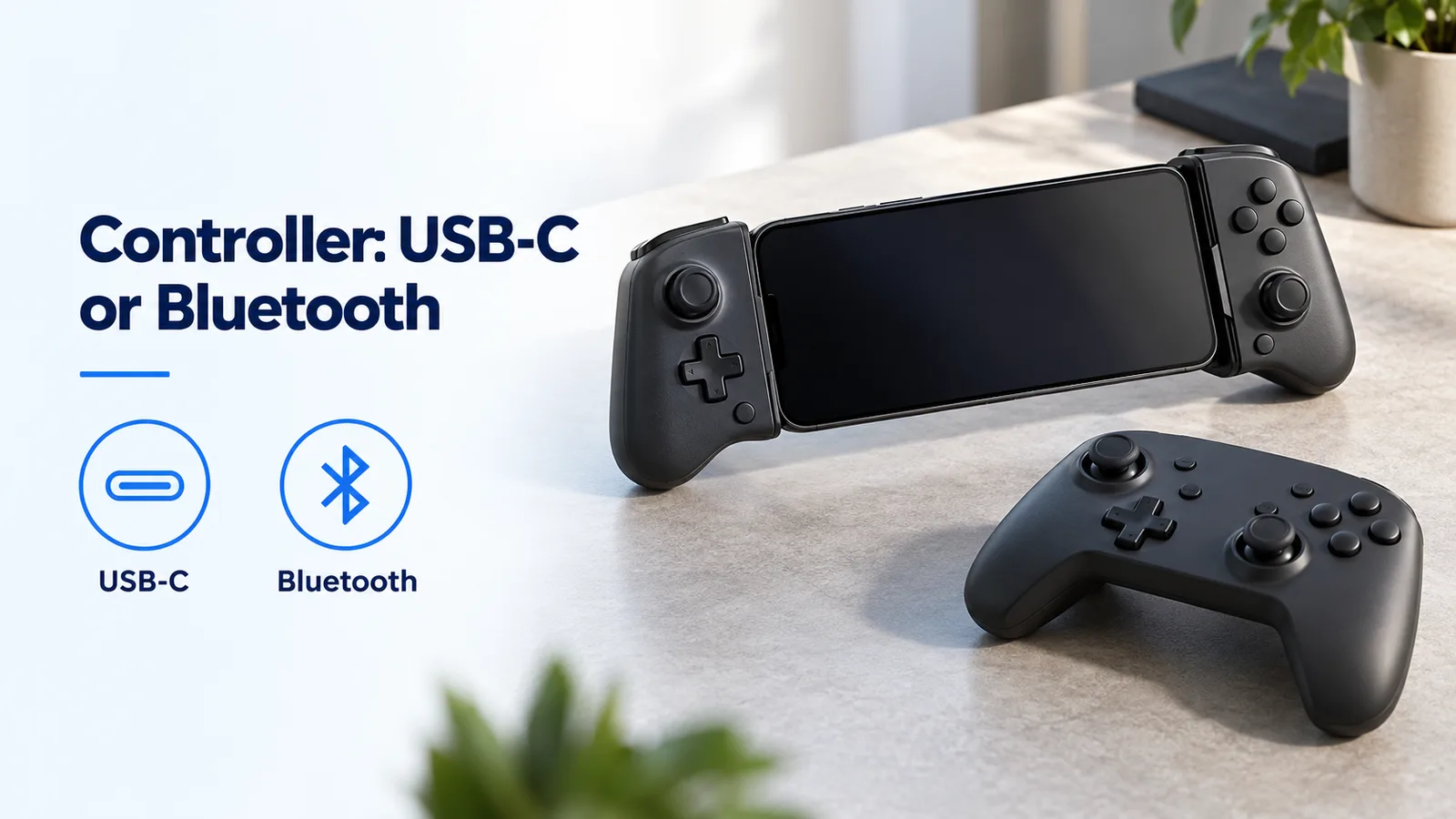
Mobile Gaming Controller: USB-C vs Bluetooth for Android
Compare USB-C and Bluetooth Android controllers by input path, game support and cooler clearance, with clear limits on latency and Hall-effect claims.
Read article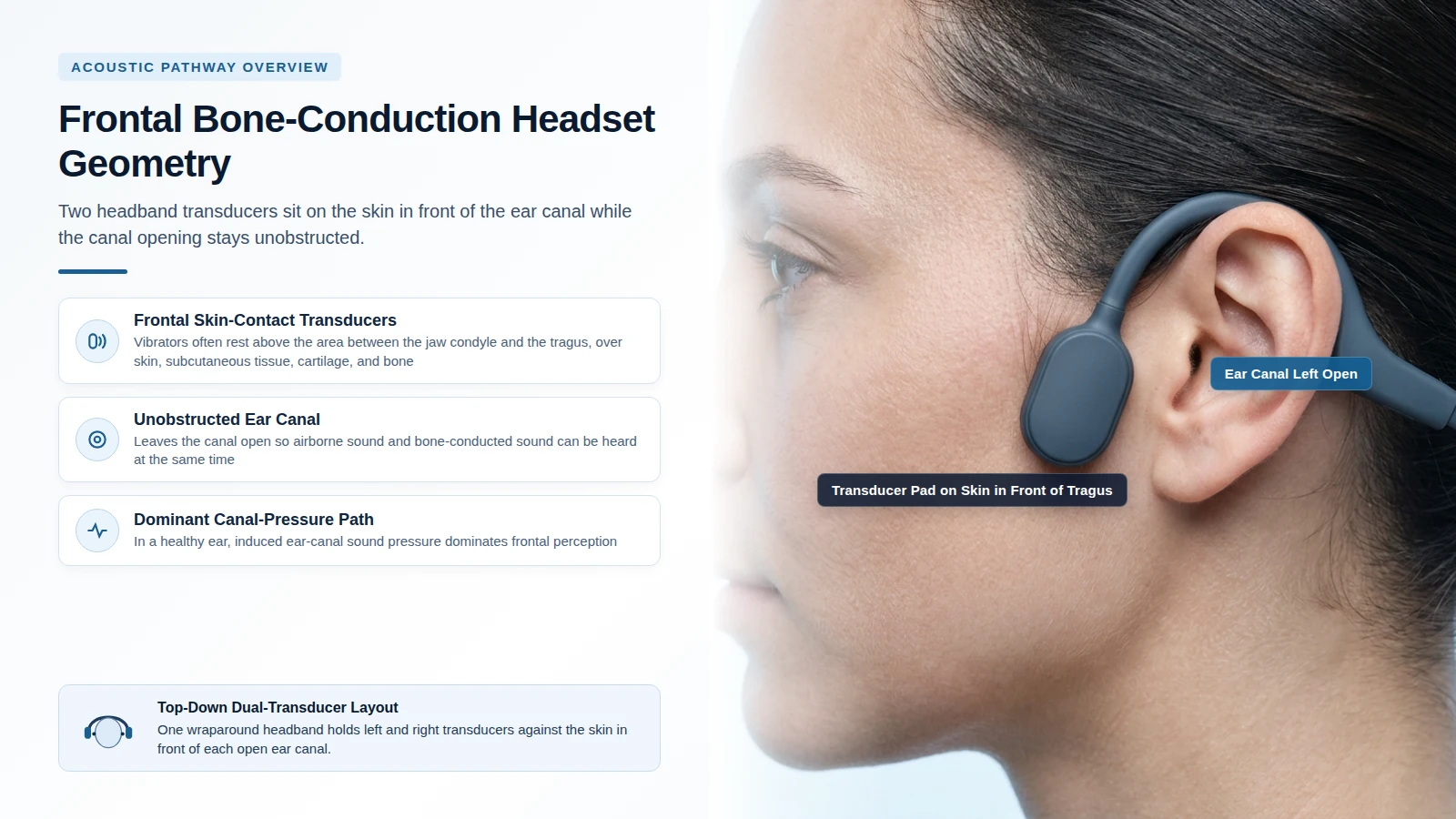
How Do Bone Conduction Headphones Work?
Bone conduction headphones vibrate skin and cartilage ahead of your open ear canal, letting headset audio and ambient sound reach the inner ear together.
Read article
USB-C Hub for Android: PD Pass-Through Math, OTG SSD Power, and exFAT Storage
Size a 100W USB-C PD pass-through hub for Android by subtracting the 7.5W–15W hub reserve, preventing NVMe SSD VBUS brownouts, and formatting drives as exFAT.
Read article