
How Do Bone Conduction Headphones Work?
How do bone conduction headphones work with an open ear canal? In a healthy ear, canal sound pressure dominates what you hear.
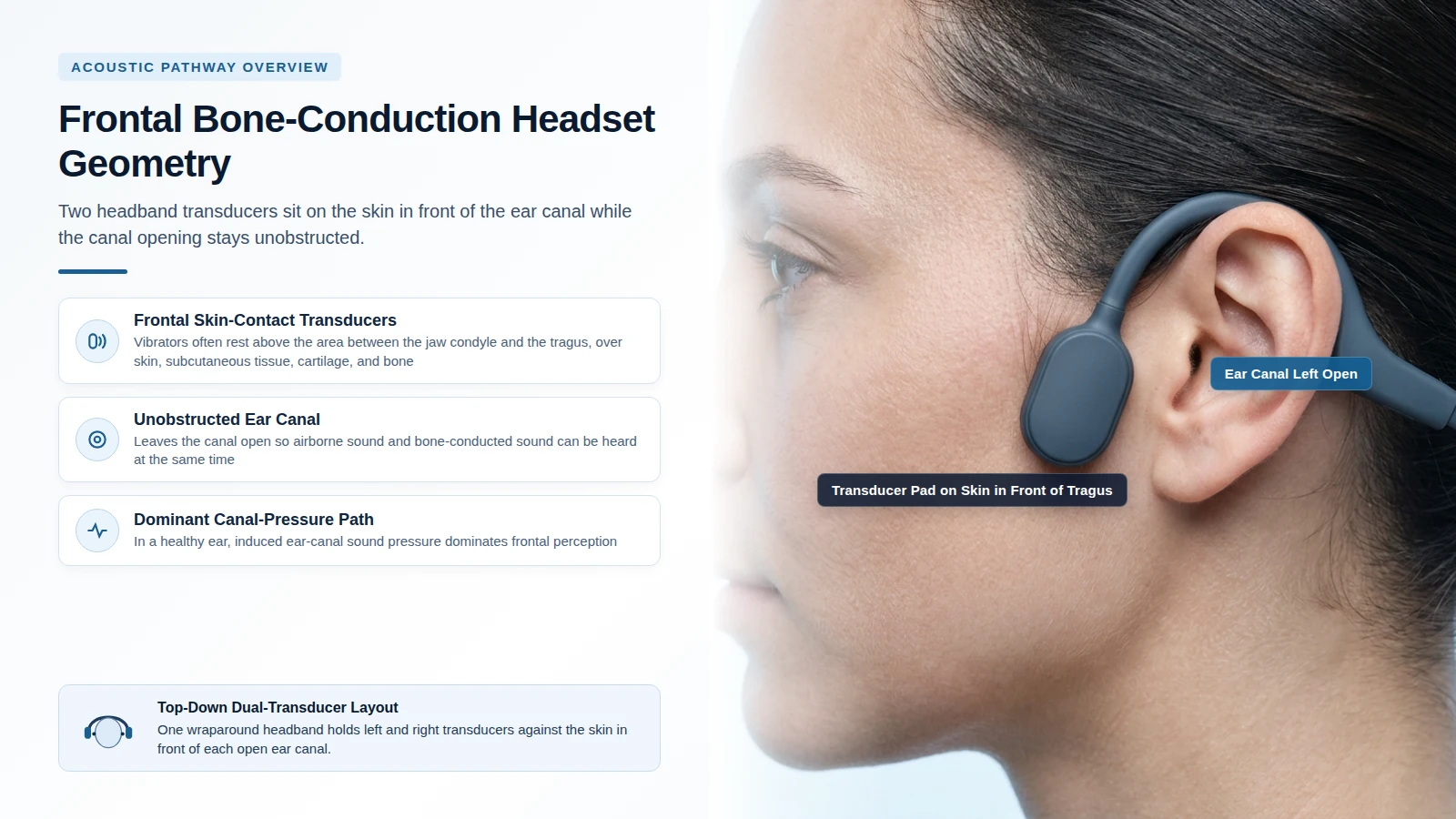
Most headsets that claim bone conduction place two transducers on the skin in front of an open ear canal, where ear-canal sound pressure dominates perception in a healthy ear.
Most bone conduction headphones use a headband to place two vibrating transducers on the skin in front of your open ear canals, converting electrical signals into vibration rather than placing an earbud inside the canal. Shokz describes bone-conduction headphones as resting against the cheekbone area in front of the ears so transducers create vibrations that travel through the skull to the inner ear while the ear canal remains open to surrounding sounds. Acoustic measurements on this frontal headset position show a narrower mechanism in a healthy ear: sound pressure induced inside the ear canal stands 20 to 30 dB above the other bone-conduction contributors and dominates perception, so sound transmission to the inner ear is similar to air conduction and the outer and middle ear still affect sensitivity.
Because the ear canal stays open, people choosing bone conduction headphones for running, driving, or public places can hear airborne environmental sound—such as conversations, announcements, or traffic—at the same time as headset audio, though vibration around the ear changes how lower frequencies are perceived and an open canal does not block surrounding noise. Before pairing a headset with your phone or adding other gear, review our Android accessories overview to check how audio hardware fits into the rest of your setup.
What are bone conduction earphones, and where do the pads sit?
In ordinary air-conduction hearing, sound waves enter the outer ear and travel through the narrow ear canal to the eardrum, as documented by the NIDCD guide on how we hear. The eardrum vibrates and sends those vibrations to three tiny middle-ear bones—the malleus, incus, and stapes—which amplify the sound vibrations and send them to the fluid-filled cochlea in the inner ear. Rippling cochlear fluid forms a traveling wave along the basilar membrane, sensory hair cells sitting on top of that membrane ride the wave, and the sound stimulates the basilar membrane and the auditory neurons.
At the core of a bone-conduction device is a bone-conduction vibrator, a transducer that converts an electrical signal into vibration. Under the general definition summarized on Wikipedia’s bone conduction overview, bone conduction conducts sound to the inner ear primarily through the bones of the skull, allowing the hearer to perceive audio content even if the ear canal is blocked. Clinical hearing assessment and hearing aids have mainly applied bone-conduction stimulation at the mastoid behind the ear, whereas communication headsets use a different placement from that mastoid site and from the percutaneous bone-conduction implant position.
In a Trends in Hearing study (Surendran, Prodanovic, and Stenfelt), the authors note that most communication headsets claiming bone conduction use a headband with two transducers placed onto the skin in front of the ear canal opening. That transducer position is often superior to the area between the condyle of the lower jaw and the tragus, over skin, subcutaneous tissue, cartilage, and bone, while Shokz describes the contact area as the cheekbone and temple in front of the ears.
With bone-conduction stimulation on skin-covered skull bone, hearing research describes five transmission pathways to the inner ear:
- Ear-canal sound pressure: Sound pressure induced in the ear canal that is transmitted to the inner ear via the middle-ear ossicles.
- Middle-ear ossicle inertia: Inertial effects on the middle-ear ossicles causing relative motion between the stapes footplate and the surrounding bone.
- Cranial-cavity sound pressure: Sound pressure created in the cranial cavity and cerebrospinal fluid that is transmitted to the inner ear via compliant pathways.
- Inner-ear fluid inertia: Inertial effects of the inner-ear fluid causing fluid motion, which model simulations suggest is the most important pathway in a normal healthy ear under classical skull-bone stimulation.
- Inner-ear space compression: Compression and expansion of the inner-ear space from surrounding bone vibration, causing a net fluid flow over the basilar membrane.
Four of those five pathways depend on skull bone vibration. Ear-canal sound pressure can be partly independent of skull bone vibration when vibration is applied close to the ear canal and on the cartilage. With stimulation close to the ear canal—such as with the Aftershokz headset used in that study—sound in the ear canal sits 20 to 30 dB higher than other bone-conduction contributors at most frequencies in a healthy ear. With the same dynamic stimulation force, frontal application generated ear-canal sound pressure 20 to 40 dB higher than mastoid application behind the ear.
That frontal mechanism sets a clear clinical boundary. Because ear-canal sound pressure dominates perception at the frontal headset position in a healthy ear, transmission to the inner ear is similar to air conduction and the status of the outer and middle ear affects hearing sensitivity. Surendran et al. estimate that frontal sensitivity is 20 to 30 dB lower in an ear with conductive loss than in a healthy ear, and conclude that a position close to the ear canal is not appropriate for clinical hearing assessment because conductive hearing loss affects bone-conduction and air-conduction thresholds by a similar amount.
Keep ordinary headsets separate from hearing implants and specialized underwater or high-noise hardware as well. Wikipedia’s bone-conduction overview categorizes products into three groups: ordinary hands-free headsets or headphones, bone-anchored hearing aids and assistive listening devices, and specialized communication products for underwater or high-noise environments. Non-surgical bone-conduction audio processors vibrate both skin and bone to conduct vibrations to the cochlea, attaching via headbands, adhesives, or bone-conduction glasses. The underwater scuba-diver speaker described in that same overview is a rubber over-moulded piezoelectric flexing disc approximately 40 millimetres (1.6 in) across and 6 millimetres (0.24 in) thick that straps against a dome-shaped bone protrusion behind the ear—distinct from the transducers placed in front of the ear canal on an open-ear headset.
How does bone conduction differ from open-ear air conduction and in-ear earbuds?
Both bone-conduction headphones and open-ear air-conduction headphones keep the ear canal open rather than placing an earbud inside it, as Shokz notes in its comparison of the two formats. Open-ear air-conduction headphones work like small speakers positioned near the ear, sending sound through the air toward the ear opening without sitting inside the canal. Bone-conduction headsets place vibrating transducers against the skin in front of the ears so airborne sound and bone-conducted sound can be heard simultaneously.
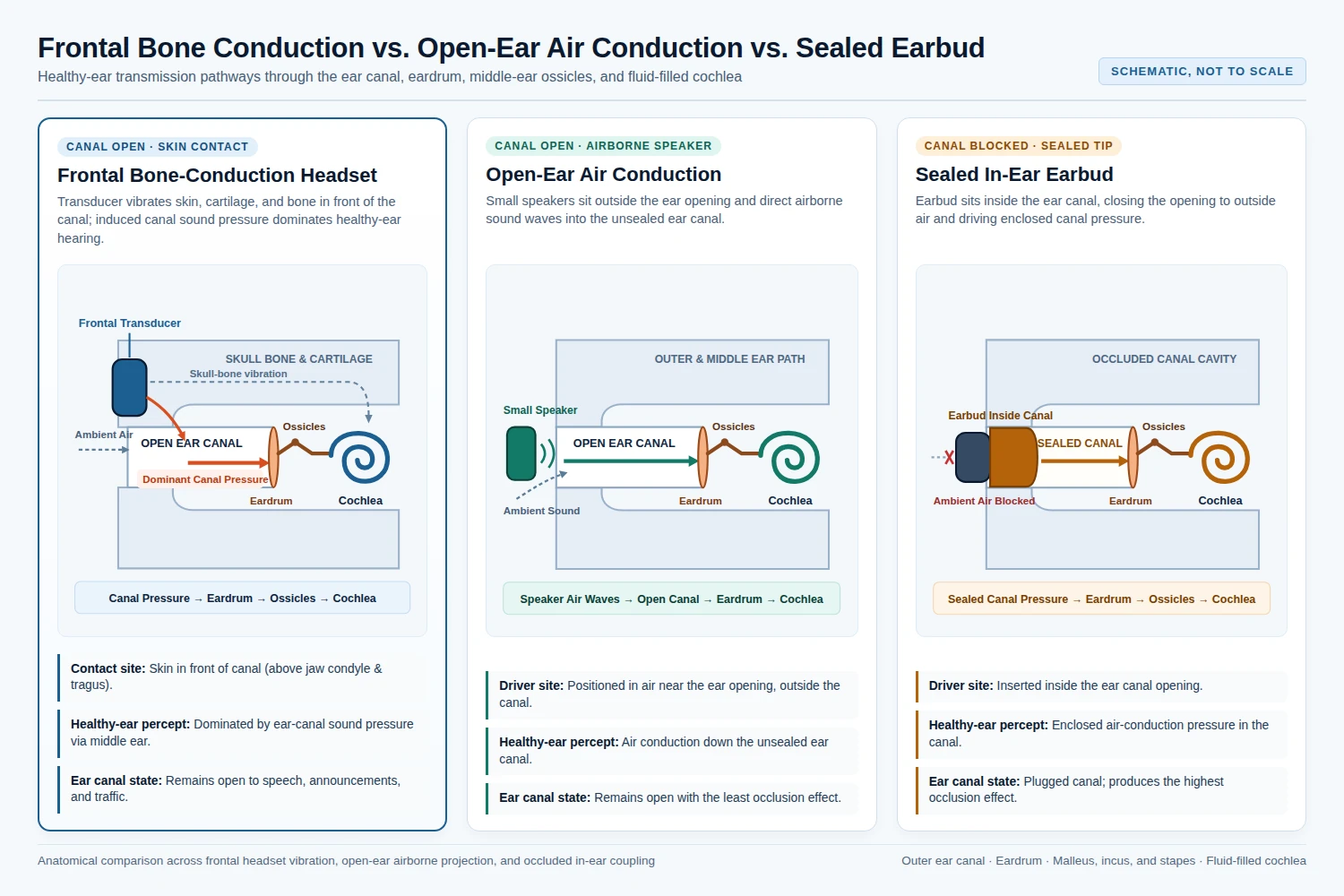
In a healthy ear, sound transmission from a frontal bone-conduction headset to the inner ear is similar to air conduction because ear-canal sound pressure dominates perception and travels to the inner ear via the middle-ear ossicles. Placing the transducer close to the ear canal opening improved sensitivity for bone-conducted sound by around 20 dB, and by up to 40 dB at some frequencies, in threshold assessments—a detection sensitivity gain rather than a music-loudness rating. Transcranial transmission across the head at that near-canal position typically ranges between −40 dB and −25 dB, facilitating the saliency of binaural cues and making bone-conduction headsets suitable for virtual and augmented reality applications.
Scroll horizontally to see all columns.
| Listening format | Driver placement | Ear canal state | Primary healthy-ear transmission path | Occlusion and ambient behavior |
|---|---|---|---|---|
| Frontal bone-conduction headset | Two transducers on skin in front of the ear canal opening, above the jaw condyle and tragus | Open | Induced ear-canal sound pressure (20 to 30 dB above other bone-conduction pathways) via eardrum and ossicles | Open ear canal keeps conversations, announcements, and traffic audible depending on volume, fit, and noise |
| Open-ear air conduction | Small speakers positioned near the ear opening | Open | Sound sent through the air toward the open ear canal, eardrum, ossicles, and cochlea | Open ear canal keeps surrounding sounds audible without skin-vibration pads |
| Sealed in-ear headphones | Earbud placed inside the ear canal | Blocked | Sound waves sent into the closed ear canal to the eardrum, ossicles, and cochlea | Produces the highest occlusion effect compared with fully open headphones |
Transducer position and ear-canal occlusion also interact strongly. In a Trends in Hearing study evaluating eleven normal-hearing participants across three stimulation positions and four headphone occlusion conditions (Wang et al.), stimulation at the condyle gave the best hearing thresholds, speech intelligibility, and music sound quality, whereas stimulation at the temple gave the worst performance across all three measures. In that same study, in-ear headphones produced the highest occlusion effect while fully open headphones produced the least occlusion effect, and greater ear-canal occlusion improved bone-conducted speech intelligibility, especially for the temple stimulation position.
Where do bone conduction headphones fall short on bass, noise, and sound leakage?
Leaving the ear canal unobstructed creates structural trade-offs in bass presentation and noisy-environment clarity. As Shokz notes, bone conduction sends vibration through the structures around the ear rather than relying solely on a conventional speaker moving air into the ear, which changes how lower frequencies are perceived and creates a different sense of bass. If you wear an open-ear band in noisy public places expecting ear-canal isolation and conventional speaker bass, surrounding environmental noise still reaches your open ears alongside the headset audio.
Raising headphone volume to overpower surrounding noise carries a direct hearing cost. The WHO safe-listening Q&A recommends well-fitted noise-cancelling headphones to reduce the need to raise volume in noisy situations—isolation that an open ear canal does not provide. Exposure to loud sounds over time causes fatigue of sensory cells in the ear, resulting in temporary hearing loss or tinnitus. For weekly listening duration, WHO gives an example of 80 dB for up to 40 hours a week, whereas at 90 dB safe listening time drops to four hours per week. WHO also advises keeping device volume at no more than 60 percent of maximum—a device-level setting rather than a decibel reading—and staying below an 80 dB average when using an app to monitor sound level.
Separately, the NIDCD noise-induced hearing loss guide states that sounds at or below 70 A-weighted decibels (dBA) are unlikely to cause hearing loss even after long exposure, while long or repeated exposure at or above 85 dBA can cause hearing loss. NIDCD lists listening at high volume through earbuds or headphones among recreational activities that put listeners at risk for noise-induced hearing loss, and notes that most noise-induced hearing loss is caused by damage and death of inner-ear hair cells, which do not grow back in humans. Because bone-conduction signals still stimulate the cochlea and its hair cells, leaving the ear canal open does not exempt high-volume headphone listening from inner-ear damage.
What about people sitting nearby? Wang et al. note, citing Chang et al. (2018), that sound leakage to the surrounding air is low, giving bone conduction advantages in military and emergency-rescue environments. In Surendran et al.’s measurement on the Aftershokz transducer, airborne sound from the transducer was 10 to 30 dB below the ear-canal sound pressure at frequencies up to 8 kHz and around 5 dB below at frequencies of 10 kHz and above, suggesting that the sound in the ear canal is not airborne radiation from the transducer. That comparison measures airborne transducer sound against ear-canal sound pressure at the wearer rather than setting a distance at which people nearby hear nothing.
Do bone conduction headphones cause temple pressure or clash with glasses?
Long-session comfort and eyewear fit depend on where the transducers rest and how frames share the space around the ear. Because the transducers remain in contact with the area around the cheekbone and temple, Shokz notes that some listeners may notice pressure in those areas during longer sessions, and the experience can vary from person to person. Wang et al. also note that bone-conduction headphones have become popular for sports, driving, public places, and military communication because the open ear canal maintains sensitivity to environmental sounds, while an optimal vibrator position improves user experience and can reduce device power consumption, increasing usage time.
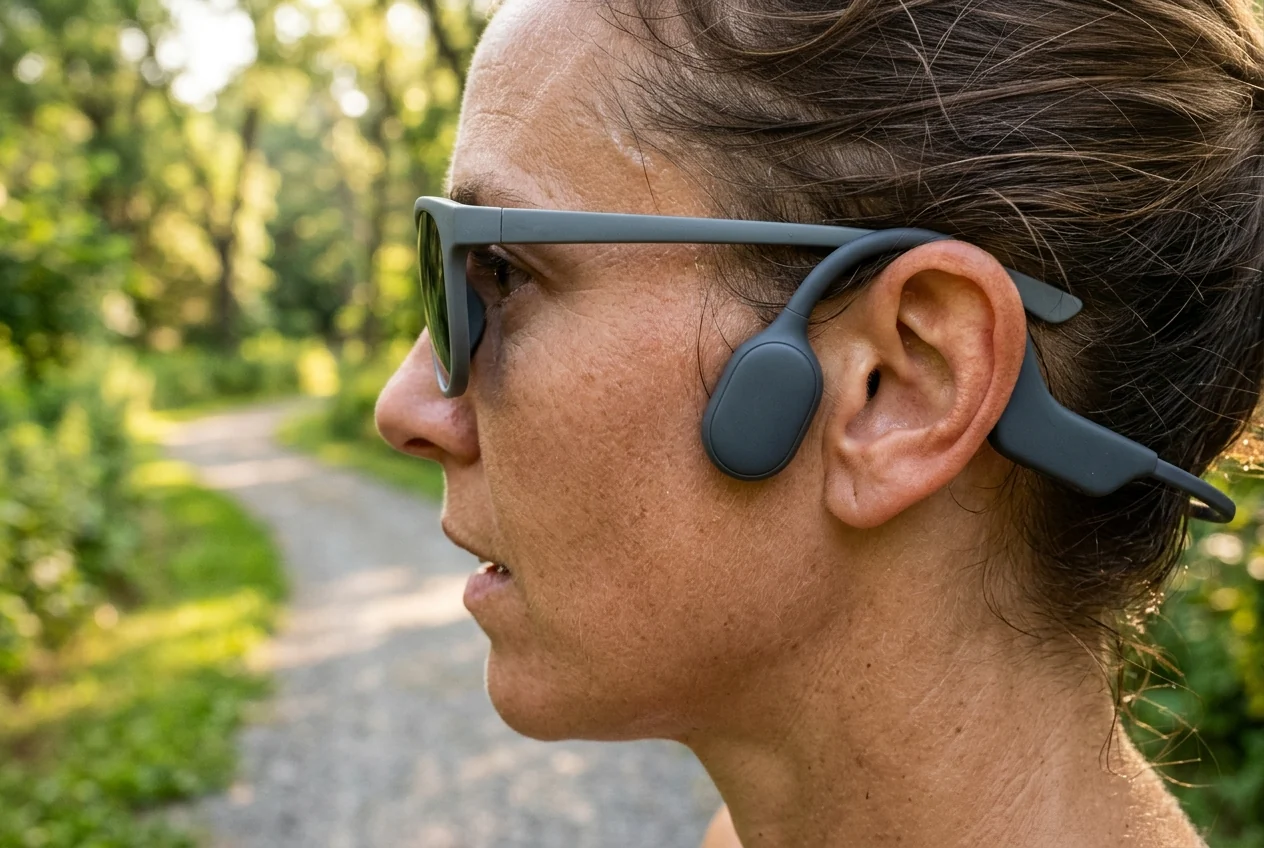
For people who wear glasses or sunglasses, Shokz notes that leaving the ear canal empty can work well, though the interaction between the headset frame, glasses arms, and head shape still depends on individual fit. Check your own glasses frames with the headband before a workout, and keep Shokz’s safety limit in view: bone conduction does not make an activity inherently safer, because volume level, fit, and environmental noise still affect how much nearby conversation, announcement, or traffic sound reaches your ears.
How should you read IP water marks and Android Bluetooth codecs?
Sport headset listings combine enclosure water-resistance marks with Bluetooth radio terms that behave differently across splashes, water jets, immersion, and Android versions. Under IEC 60529, summarized on Wikipedia’s IP code reference, an Ingress Protection (IP) code classifies the degree of protection provided by mechanical casings and electrical enclosures against intrusion, dust, accidental contact, and water rather than applying to bone-conduction headphones as a class:
- Letter X and hyphen formatting: An X in a position such as IPX5 or IPX7 means no data is available to specify a protection rating for that criterion. Standard IP codes contain no hyphens, making a listing mark like IPX-8 invalid.
- Non-cumulative water digits past IPX6: Water ingress ratings are not cumulative beyond IPX6, so a device compliant with IPX7 for water immersion is not necessarily compliant with IPX5 or IPX6 exposure to water jets.
- Key water digits compared: Digit 4 covers splashing of water from any direction; digit 5 covers water projected by a nozzle (water jets) from any direction; digit 7 covers immersion up to 1 meter depth for 30 minutes; and digit 8 covers continuous immersion under conditions specified by the manufacturer, generally up to 3 meters and expected to exceed IPX7 requirements.
On the wireless side, Bluetooth SIG documentation separates Classic Audio, which operates on the Bluetooth Classic radio using asynchronous ACL transport and many buffers, from Bluetooth LE Audio, which operates on the Bluetooth Low Energy radio using time-synchronized LE Isochronous Channels introduced in Bluetooth Core 5.2 so fewer buffers are needed and delays are shorter. LE Audio includes the Low Complexity Communications Codec (LC3) so designers can balance audio quality and power consumption; Bluetooth SIG listening tests showed LC3 provides audio-quality improvements over Classic Audio’s SBC codec even at a 50 percent lower bit rate.
Android handsets negotiate whichever path both devices support:
- Classic A2DP negotiation: Per Android Open Source Project (AOSP) Bluetooth services documentation, Android’s Bluetooth stack selects the best codec supported by both the sender and the audio sink, then routes audio through that encoder. On Android 8.0, devices that support A2DP automatically gain AAC, aptX, aptX HD, and LDAC besides SBC, and device manufacturers can choose which codecs their devices attempt to use first.
- Android 13 LE Audio and voice calls: Android Developers’ BLE Audio overview notes that Android 13 (API level 33) includes built-in LE Audio support on compatible devices, and most LE Audio headsets are expected to stay dual mode until LE Audio source-device support grows, allowing users to pair and set up both transports. On the LE Audio path, LC3 is the default codec replacing SBC for A2DP media and mSBC for HFP voice; whereas Bluetooth Classic lowers audio quality when Bluetooth microphones are active, BLE Audio input and output sampling can reach 32 kHz.
Before ordering any headset, record your phone’s exact model and wireless support using our Android device compatibility checklist. If you are comparing wireless audio against a wired stereo connection in a vehicle rather than choosing a wearable headset, read our separate guide on USB-C DAC line-in versus Bluetooth audio clarity in cars.
Workout and commute comparison checklist
Use this side-by-side checklist to evaluate candidate bone-conduction, open-ear air-conduction, and sealed in-ear models against your workout or commute requirements:
Scroll horizontally to see all columns.
| Check item | Bone conduction | Open-ear air conduction | Sealed in-ear |
|---|---|---|---|
| Canal open or blocked (skin-contact pads in front of the canal, small speakers near the ear opening, or a tip inside the canal) | [ ] | [ ] | [ ] |
| Whether noise isolation is the goal (open canal for nearby speech, announcements, and traffic versus well-fitted noise-cancelling headphones in noise) | [ ] | [ ] | [ ] |
| Whether lower frequencies matter (vibration around the ear alters low-frequency bass perception compared with air-moving speakers) | [ ] | [ ] | [ ] |
| Glasses arms and the rear band (cheekbone and temple contact on longer sessions plus eyewear frame and head-shape fit) | [ ] | [ ] | [ ] |
| Printed IEC 60529 water code (exact unhyphenated enclosure mark such as digit 4 splash, IPX5, IPX6, IPX7, or IPX8; non-cumulative past IPX6) | [ ] | [ ] | [ ] |
| Shared phone and headset codec (Classic A2DP SBC, AAC, aptX, aptX HD, or LDAC, or Android 13 LE Audio LC3) | [ ] | [ ] | [ ] |
Frequently asked questions
Can people nearby hear bone conduction headphones?
Wang et al. (citing Chang et al., 2018) report that sound leakage to surrounding air is low, and Surendran et al. measured airborne sound from an Aftershokz transducer at 10 to 30 dB below the wearer’s ear-canal sound pressure at frequencies up to 8 kHz. That comparison suggests the sound in the ear canal is not airborne radiation from the transducer, while what people nearby hear still depends on volume and environmental noise.
Can bone conduction headphones bypass conductive hearing loss like a clinical test?
No. Surendran et al. found that at the frontal position in front of the ear canal, ear-canal sound pressure dominates healthy-ear perception by 20 to 30 dB over other pathways, so conductive hearing loss lowers frontal sensitivity by 20 to 30 dB and affects bone-conduction and air-conduction thresholds by a similar amount, making near-canal placement inappropriate for clinical use.
Does an IPX7 water rating cover nozzle water jets?
Not automatically. Under IEC 60529 as documented on Wikipedia’s IP code page, water ingress ratings are not cumulative beyond IPX6: IPX7 covers immersion up to 1 meter depth for 30 minutes, and that immersion rating does not by itself include IPX5 or IPX6 water-jet protection.
Sources
- National Institute on Deafness and Other Communication Disorders (NIDCD) — How Do We Hear?
- National Institute on Deafness and Other Communication Disorders (NIDCD) — Noise-Induced Hearing Loss
- World Health Organization (WHO) — Deafness and hearing loss: Safe listening
- Surendran, Prodanovic, and Stenfelt — Hearing Through Bone Conduction Headsets, Trends in Hearing
- Wang, Stenfelt, Wu, Yan, Sang, and Zheng — The Effect of Stimulation Position and Ear Canal Occlusion on Perception of Bone Conducted Sound, Trends in Hearing
- Wikipedia — Bone conduction
- Wikipedia — IP code (IEC 60529)
- Shokz — Air Conduction vs. Bone Conduction: Open-Ear Headphones Guide
- Bluetooth SIG — LE Audio; Improving latency and broadening audio horizons with Bluetooth LE Audio
- Android Open Source Project — Bluetooth services; Android Developers — Bluetooth Low Energy Audio
Related articles
USB-C Hub for Android: PD Pass-Through Math, OTG SSD Power, and exFAT Storage
Size a 100W USB-C PD pass-through hub for Android by subtracting the 7.5W–15W hub reserve, preventing NVMe SSD VBUS brownouts, and formatting drives as exFAT.
Read article
Mobile Gaming Controller: USB-C vs Bluetooth for Android
Compare USB-C and Bluetooth Android controllers by input path, game support and cooler clearance, with clear limits on latency and Hall-effect claims.
Read articleAndroid Auto GPS Wrong Location: Phone and Projection Checks
Diagnose an Android Auto Google Maps location issue by separating wrong blue-dot position, spinning compass beams, and unloaded routes while parked.
Read article