
Portable Phone Charger for Android: 45W 5A PPS & 21V Pixel Guide
Why a 65W laptop power bank limits Samsung Ultra and Pixel phones to 15W–18W, and how to match 3.3–11V/5A or 3.3–21V PPS ranges and 5A E-Marker cables.
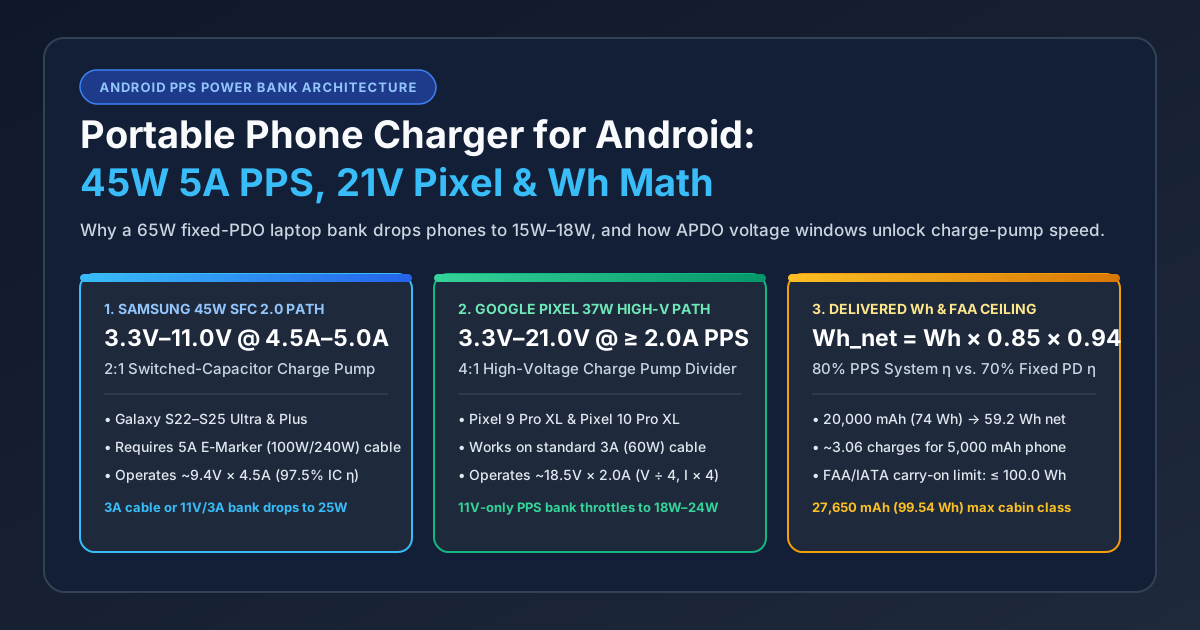
Full-speed Android portable charging requires matching either Samsung's 3.3V–11V at 4.5A–5A PPS window (with a 5A E-Marker cable) or Google Pixel's 3.3V–21V high-voltage PPS window.
Plugging a 65W or 100W laptop power bank into a Samsung Galaxy Ultra or Google Pixel Pro XL fails to unlock peak charging speed and wastes energy as step-down heat inside the phone when the pack lacks the required Programmable Power Supply (PPS) voltage window. Pairing a 5A PPS power bank with a standard 60W (3A) USB-C cable also causes the power bank controller to reject 45W Samsung Super Fast Charging 2.0 by capping current at 3.0A.
A generic 65W or 100W laptop power bank charges Samsung Galaxy Ultra and Google Pixel phones at only 15W to 18W (9V × 1.67A–2.0A) when it outputs only Fixed USB-PD voltages (5V/9V/15V/20V). Reaching 45W Samsung Super Fast Charging 2.0 requires a 3.3V–11.0V @ 4.5A–5.0A PPS power bank plus a 5A E-Marker cable, while 37W Pixel 9/10 Pro XL charging requires a 3.3V–21.0V @ ≥2.0A PPS rail. Use the Android charging hub, our Charging & Power archive, and the USB PD vs. PPS protocol guide to match your handset’s charging architecture before ordering from the Android accessories collection.
Updated October 25, 2026.
Scroll horizontally to see all columns.
| Smartphone Series | Peak Wired Mode | PMIC Topology | Required PPS APDO Window | Cable Requirement | 65W Fixed-PD Fallback |
|---|---|---|---|---|---|
| Galaxy S22–S25 Ultra & Plus, Tab S8–S10 Ultra | 45W SFC 2.0 |
Dual 2:1 pump |
3.3–11V @ 4.5–5A (~9.4V × 4.5A) |
5A E-Marker (100W/240W) |
25W on 3A cable; 15W–18W no PPS |
| Galaxy S22–S25 (Base), Z Fold/Flip, A54/A55 | 25W SFC 1.0 |
Single 2:1 pump |
3.3–11V @ 2.25–3A (~9.0V × 2.77A) |
Standard 3A (60W) |
15W Fixed PD (9V × 1.67A) |
| Google Pixel 9 Pro XL & Pixel 10 Pro XL | 37W Fast Charge |
High-V 4:1 pump |
3.3–21V (20V Prog) @ ≥ 2.0A |
Standard 3A (60W) |
18W–24W if PPS stops at 11V/16V |
| Google Pixel 8/8 Pro, 9/9 Pro, 10/10 Pro | 27W–30W Fast Charge |
2:1 charge pump |
3.3–11V @ 3.0A (~9.5V × 3A) |
Standard 3A (60W) |
15W–18W Fixed PD (9V × 2A) |
| OnePlus 12 / 13, OnePlus Open, Oppo Find X | 80W–100W SUPERVOOC |
2S cell + 2:1 pump |
11V @ 7.3–9.1A; 3.3–11V @ 3–4A PPS |
SUPERVOOC or 5A USB-C |
18W (OnePlus 11); 27W–45W (12/13) |
| Xiaomi 13 / 14 / 15 Pro & Ultra, Poco F6/F7 | 90W–120W HyperCharge |
4:1 pump + CC VDM |
3.6–20V @ 4.5–6A (Xiaomi VDM) |
Xiaomi 6A or 5A E-Marker |
18W–27W open PD; 120W on CUKTECH |
Why Generic 65W and 100W Laptop Power Banks Throttle Android Phones to 15W–18W
A portable charger’s headline wattage rating indicates the maximum power it delivers on its highest laptop voltage rail, not what an Android smartphone draws from it. Under the USB-IF Power Delivery 3.0 and 3.1 specification, a generic "65W" or "100W" laptop power bank reaches its advertised output only on the Fixed 20V Power Data Object (PDO): 20V × 3.25A = 65W or 20V × 5A = 100W, alongside lower Fixed PDO rails at 5V × 3A (15W), 9V × 2A–3A (18W–27W), and 15V × 3A (45W).
Most Android phones use a single-cell (1S) lithium-ion battery whose voltage swings from 3.60V empty to 4.45V full. A 1S smartphone Power Management IC (PMIC) refuses to sink a fixed 20V or 15V rail into its battery charger because stepping 20V down to 4.2V inside an 8 mm handset causes severe switching heat. When a power bank advertises only Fixed PDOs without Programmable Power Supply (PPS), the phone selects the Fixed 9V rail at 1.67A (15W) or 2.0A (18W), or 5V × 3A (15W). Compare adapter labels against phone limits in How Many Watts Does Your Android Phone Actually Need? and Can You Use a Laptop USB-C Charger With an Android Phone?.
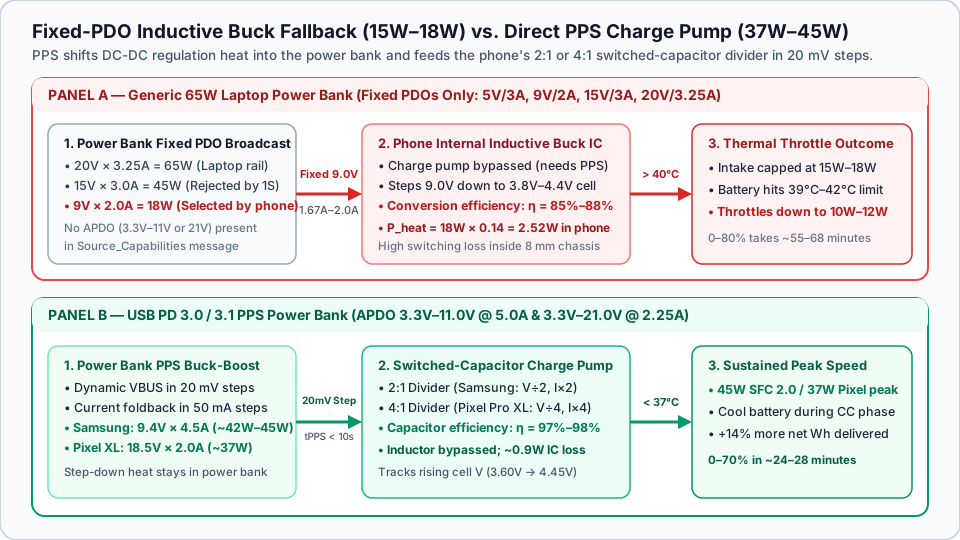
The efficiency gap between a Fixed-PDO bank and a USB-IF Certified PPS Fast Charger depends on which internal charging circuit engages:
Formula: P_phone_heat = P_input_VBUS × (1 − η_phone_converter)
Worked example: Compare internal handset heat on an 18W Fixed-PDO rail versus a 42W Direct PPS rail:
- Fixed 9V PDO Path (Inductive Buck at
η = 86%): Stepping fixed9Vdown to~4.2Vinside the phone dissipates18W × (1 − 0.86) = 2.52Was PCB heat. Within 12 minutes, battery temperature crosses39°C to 42°C, triggering PMIC thermal throttling down to10W–12W. - Direct PPS Path (
2:1or4:1Charge Pump atη = 97.5%): Under USB PD 3.0/3.2 PPS (Table 4.2andTable 6.21), the phone closes a switched-capacitor divider (TI BQ25970,NXP PCA9468, orSouthchip SC8571) that halves (V_in ÷ 2) or quarters (V_in ÷ 4) incoming voltage while doubling or quadrupling current with no inductor. At97.5%efficiency, a42WPPS charge generates only42W × (1 − 0.975) = 1.05Wof internal IC heat.
Because a capacitor divider cannot regulate voltage alone, the phone sends a PPS_Request packet over the USB-C CC line every < 10 seconds (tPPSRequest timeout), commanding the power bank’s synchronous buck-boost converter to step VBUS in 20 mV increments and current limits in 50 mA increments.
Rule of thumb: Never judge an Android power bank by its 65W or 140W Fixed-PDO headline; inspect the fine-print PPS output row on the casing.
Samsung Super Fast Charging (25W vs. 45W SFC 2.0): The 11V/5A PPS and E-Marker Handshake
As documented in Samsung’s 45W USB-C PD 3.0 PPS Travel Adapter (EP-TA845) specification and Samsung’s Fast Charging support guide, Samsung splits wired fast charging into two PPS tiers:
1. Super Fast Charging 1.0 (25W Max)
Base Galaxy S22–S25, Galaxy Z Fold4–7, Z Flip4–7, and Galaxy A35/A54/A55 models require 3.3V–11.0V @ 2.25A–3.0A PPS (~9.0V × 2.77A = 25W), run at full speed over a standard 3A (60W) USB-C cable, and display a green charging ring.
2. Super Fast Charging 2.0 (45W Max)
Galaxy S22+ through S25+, Galaxy S22–S25 Ultra, and Galaxy Tab S8–S10 Plus/Ultra models use a dual-phase 2:1 charge pump rated up to 45W. Unlocking 45W SFC 2.0 from a power bank requires passing two hardware gates:
- Gate 1 (
4.5A–5.0APPS Window): The USB-C port must advertise3.3V–11.0V @ 4.05A–5.0APPS (~9.2V–9.8V × 4.5A = 41.4W–44.1W). (While Galaxy S25+ and S25 Ultra also support a15V Prog3.3V–16.0V @ 3.0A45Wpath over 3A cables,3.3V–11.0V @ 4.5A–5.0Aremains the universal 45W contract across all S22–S25 Ultra and Tab S Ultra generations.) - Gate 2 (
SOP'5A E-Marker Cable Check): Under the USB-IF Cable and Connector compliance rules, passive cables without an E-Marker chip are capped at3.0A(60W). On attach, the power bank queriesSOP'on theCCpin; if no5AE-Marker responds, the bank truncates its PPS advertisement from5.0Ato3.0A, dropping a Galaxy Ultra from45WSFC 2.0 (cyan/teal ring) to25WSFC 1.0 (green ring). Check cable logos in our USB-C cable guide for Android.
Formula: P_SFC2_peak = V_PPS_2x_cell × I_PPS_5A_cable = 9.4V × 4.5A = 42.3W
Worked example: Why the Anker 737 PowerCore 24K (A1289, 140W) caps a Galaxy S24 Ultra at ~25W–27W:
- The Anker 737 outputs
140W(28V × 5A) for laptops, but its PD policy table caps its3.3V–11.0VPPS APDO at3.0A(33Wmax), limiting Galaxy S22–S24 Ultra handsets to~25W–27W(SFC 1.0). - Newer packs including the Anker Prime 27,650mAh 250W (
A1340), Anker Prime 20,000mAh 200W (A1336), INIU 140W (P63-E1), CUKTECH 15 Ultra / 20 (210W), and Shargeek 170 (SP080) advertise3.3V–11.0V @ 5.0APPS for true45WSFC 2.0.
Google Pixel 9 Pro XL and Pixel 10 Series: Why 37W Charging Needs a 21V PPS Window
Instead of pushing 4.5A–5.0A over a 9V–11V rail, Google engineered the Pixel 9 Pro XL (37W peak) and Pixel 10 Pro XL (37W–45W class) around a high-voltage 4:1 switched-capacitor charge pump. As published in Google’s 45W USB-C Power Charger specs, Google’s Pixel Flex Dual Port 67W Charger sheet, and Pixel adapter requirements, Google’s 45W charger advertises PPS rails up to 11V/3A, 16V/3A, and 21V/2.25A (45W).
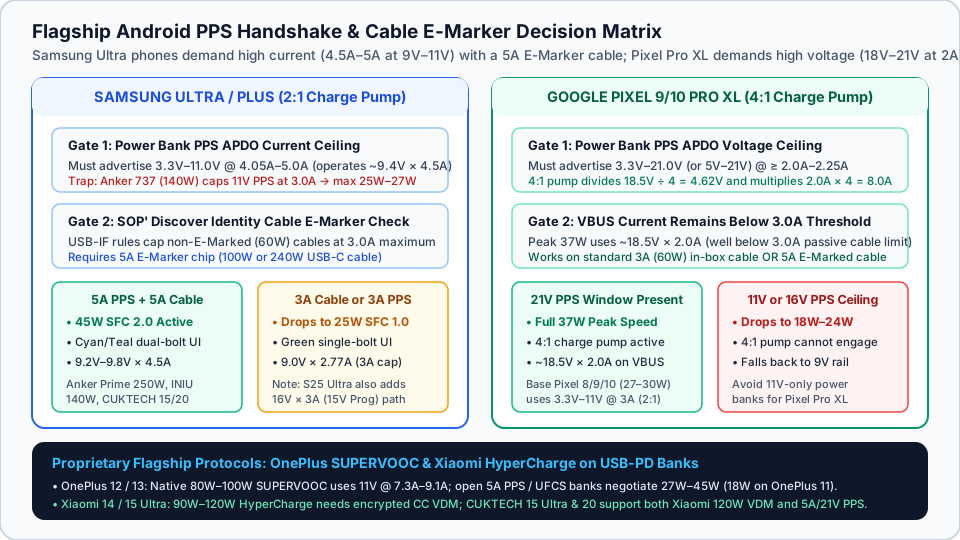
Formula: V_cell_input ≈ V_PPS_VBUS ÷ 4 and I_cell_charge ≈ I_PPS_VBUS × 4
Worked example: Tracing 37.0W high-voltage PPS into a Pixel 9 Pro XL:
- VBUS & Cable: The power bank outputs
18.5V × 2.0A = 37.0W. Because current stays at2.0A, the standard3A(60W) in-box cable carries full37Wpower without needing a5AE-Marker. - Inside the Phone (
4:1Divider): The charge pump divides18.5Vby 4 (~4.62V) and multiplies2.0Aby 4 (~7.8Ainto the battery at97.5%IC efficiency). - The
11V / 16VCeiling Trap: A power bank whose PPS ceiling stops at11.0Vor16.0V(such as the Ugreen Nexode 130WPB721) blocks the4:1charge pump and throttles the Pixel 9/10 Pro XL to18W–24W. Smaller Pixel 8, 9, and 10 Base/Pro (27W–30W) models use a2:1pump inside3.3V–11.0V @ 3.0APPS.
OnePlus SUPERVOOC, Xiaomi HyperCharge, Qi2 Magnetic Banks, and Top PPS Models Compared
- OnePlus / Oppo / Realme (
SUPERVOOC65W–100Wvs. Open PPS): Dual-cell (2S) flagships like the OnePlus 12 and 13 require proprietary11V @ 7.3A–9.1Abricks for80W–100W, but support3.3V–11.0V @ 3A–4APPS / UFCS (27W–45W) on 5A PPS power banks (older OnePlus 10/11 models cap at18W). - Xiaomi / Redmi / Poco (
HyperCharge90W–120WVDM PPS): Xiaomi locks67W–120Wbehind encryptedCCVendor-Defined Messages (VDM), falling back to18W–27Won standard banks. CUKTECH 15 Ultra and CUKTECH 20 (P23,210W) include licensed Xiaomi120WVDM alongside open11V/5Aand21V/5AUSB-IF PPS. - Qi2 Magnetic Power Banks (
15WWireless vs. Wired PPS): A10,000 mAh(37 Wh) Qi2 magnetic power bank peaks at15Wwireless with65%–72%coil efficiency (~0.9–1.1charges, throttling above39°C). Using its USB-C port with a short cable yields20%–25%more usable capacity. See our wireless charging case compatibility guide, overheating prevention checks, and GaN charger guide.
Scroll horizontally to see all columns.
| Power Bank Model | Capacity & FAA Wh | Max USB-C1 | Published PPS APDO Range(s) | Samsung 45W? | Pixel 37W (21V)? | Est. Net Wh (80% η) |
|---|---|---|---|---|---|---|
Anker Prime 27,650mAh (A1340) |
27,650 mAh (99.5 Wh) |
140W PD 3.1 |
3.3–11V @ 5A, 3.3–21V @ 5A |
Yes (45W) |
Yes (37W) |
79.6 Wh (4.1 charges) |
CUKTECH 20 25,000mAh (P23) |
25,000 mAh (90.0 Wh) |
140W (120W VDM) |
3.3–11V @ 5A, 3.3–21V @ 5A |
Yes (45W) |
Yes (37W) |
72.0 Wh (3.7 charges) |
Anker Prime 20,000mAh (A1336) |
20,000 mAh (72.0 Wh) |
100W PD 3.0 |
3.3–11V @ 5A, 3.3–21V @ 5A |
Yes (45W) |
Yes (37W) |
57.6 Wh (3.0 charges) |
INIU 140W 25,000mAh (P63-E1) |
25,000 mAh (92.5 Wh) |
140W PD 3.1 |
3.3–11V @ 5A, 3.3–21V @ 5A |
Yes (45W) |
Yes (37W) |
74.0 Wh (3.8 charges) |
Shargeek 170 24,000mAh (SP080) |
24,000 mAh (86.4 Wh) |
140W PD 3.1 |
3.3–11V @ 5A, 3.3–21V @ 5A |
Yes (45W) |
Yes (37W) |
69.1 Wh (3.5 charges) |
Ugreen Nexode 130W (PB721) |
20,000 mAh (72.0 Wh) |
100W PD 3.0 |
3.3–11V @ 5A, 3.3–16V @ 3A |
Yes (45W) |
No (22W cap) |
57.6 Wh (3.0 charges) |
Anker 737 24K 140W (A1289) |
24,000 mAh (86.4 Wh) |
140W PD 3.1 |
3.3–11V @ 3A, 3.3–21V @ 3A |
No (25W cap) |
Yes (37W) |
69.1 Wh (3.5 charges) |
Real Delivered Capacity (Wh to mAh Derating), Multi-Port Reset, and Airline Rules
A 20,000 mAh power bank is rated at its internal cell voltage of 3.6V or 3.7V, whereas a 5,000 mAh (3.87V) Android battery stores 19.35 Wh. Convert mAh to Watt-hours (Wh) and apply the three series conversion efficiencies:
Formula: Wh_stored = (mAh_cell × V_cell_nominal) ÷ 1,000
Formula: Wh_delivered_net = Wh_stored × η_bank_buck_boost × η_USB_cable × η_phone_PMIC
Worked example: Conditional audit for a 20,000 mAh (3.7V = 74.0 Wh) pack charging a 5,000 mAh (19.35 Wh) phone (η_bank = 0.85, η_cable = 0.97):
- Via Direct PPS (
η_phone = 0.97, Netη = 80.0%):74.0 Wh × 0.85 × 0.97 × 0.97 = 59.18 Whnet (3.06 full charges). - Via Fixed 9V PD (
η_bank = 0.84,η_cable = 0.96,η_phone = 0.87, Netη = 70.1%):74.0 Wh × 0.84 × 0.96 × 0.87 = 51.91 Whnet (2.68 full charges), losing7.27 Wh(38%of a phone charge) to heat.
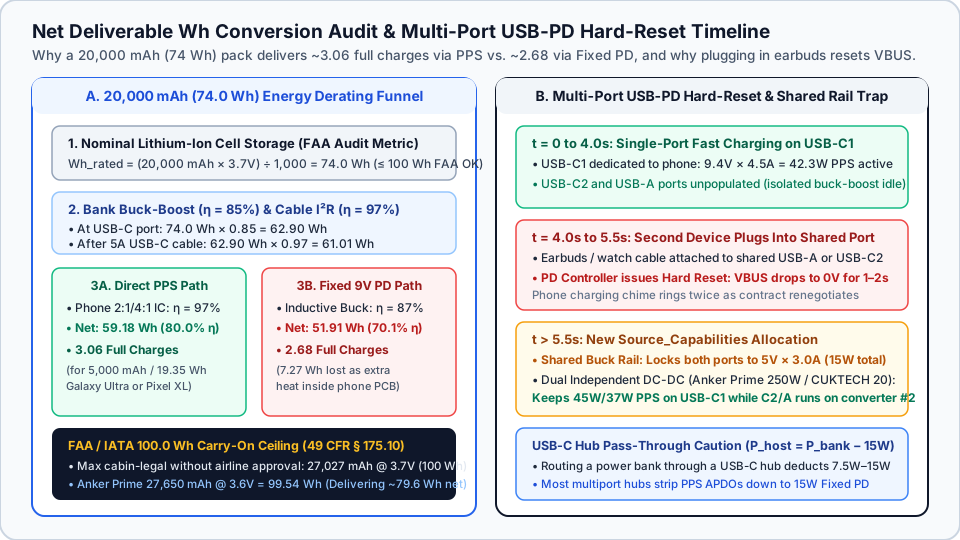
Multi-Port Re-Negotiation Reset (1–2s VBUS Drop) and FAA 100 Wh Rules
- Multi-Port Hard Reset: As noted in Anker’s multi-port power management documentation and Google’s 67W Dual-Port allocation sheet, plugging earbuds into a shared
USB-A / USB-C2port triggers a1–2s0VVBUS Hard Reset and drops shared rails to5V × 3A(15Wtotal) unless the bank uses dual isolated DC-DC converters (Anker Prime 250W/CUKTECH 20). - USB-C Hub Deduction: Routing a power bank through a multiport dock deducts
7.5W–15Wand strips PPS down to15WFixed PD; see our USB-C hub for Android PD pass-through and exFAT storage guide. - FAA / IATA
100.0 WhCarry-On Limit: Under FAA PackSafe (49 CFR § 175.10(a)(18)), lithium-ion power banks (UN 3480) are banned from checked bags and capped at100.0 Wh(27,027 mAhat3.7V) in carry-on baggage without airline approval.
Scroll horizontally to see all columns.
| Power Bank Class | Stored (Wh) |
Net PPS (80% η) |
Net Fixed PD (70% η) |
Full Charges (19.35 Wh) |
FAA Carry-On (≤ 100 Wh) |
|---|---|---|---|---|---|
10,000 mAh (3.7V) |
37.0 Wh |
29.6 Wh |
25.9 Wh |
1.53 (PPS) / 1.34 (PD) |
Carry-On OK (≤ 100 Wh) |
20,000 mAh (3.7V) |
74.0 Wh |
59.2 Wh |
51.9 Wh |
3.06 (PPS) / 2.68 (PD) |
Carry-On OK (≤ 100 Wh) |
24,000 mAh (3.6V) |
86.4 Wh |
69.1 Wh |
60.5 Wh |
3.57 (PPS) / 3.13 (PD) |
Carry-On OK (≤ 100 Wh) |
25,000 mAh (3.6V) |
90.0 Wh |
72.0 Wh |
63.0 Wh |
3.72 (PPS) / 3.26 (PD) |
Carry-On OK (≤ 100 Wh) |
27,650 mAh (3.6V) |
99.54 Wh |
79.6 Wh |
69.7 Wh |
4.11 (PPS) / 3.60 (PD) |
Carry-On OK (99.54 Wh) |
30,000 mAh (3.7V) |
111.0 Wh |
88.8 Wh |
77.7 Wh |
4.59 (PPS) / 4.02 (PD) |
Requires Airline Approval |
Rule of thumb: Multiply printed Wh by 0.80 (PPS) or 0.70 (Fixed PD) and divide by 19.35 Wh to get real 0% to 100% charges for a 5,000 mAh phone.
5-Minute Pre-Purchase and Slow-Charge Diagnostic Checklist
Run this five-step check and record your setup on our 5-minute Android accessory compatibility checklist:
- Check the Fine-Print
PPSCasing Row: ConfirmUSB-C1printsPPS 3.3V–11.0V = 4.5A–5.0A(Samsung45W) orPPS 3.3V–21.0V = 2.0A–5.0A(Pixel 9/10 Pro XL37W). - Use a
5AE-Marker Cable (100W/240WLogo) for Samsung 45W: Replace the3A(60W) in-box cable with a5AE-Marked cable for45WSFC 2.0. - Test Below
30%SoC and< 35°CBattery Temp: Peak37W–45Wdraw occurs only between0% and ~35%battery with the screen off; see our Android phone charging slowly diagnostic order. - Unplug Secondary Cables from Shared Ports: Keep
USB-AandUSB-C2empty on single-converter banks to prevent a5V × 3A(15W) fallback. - Pair a
65W–140WWall Charger for Fast Refills: Refill86–99.5 Whpacks in35–55 minutesusing a 65W–140W laptop USB-C charger or GaN wall adapter.
Scroll horizontally to see all columns.
| Observed Symptom | Root Electrical Cause | Verification Check | Exact Hardware Fix |
|---|---|---|---|
Galaxy Ultra shows green ring (25W) on 100W+ bank |
3A cable lacks SOP' 5A E-Marker, or bank caps 11V PPS at 3.0A (Anker 737) |
Check cable for 100W/240W logo and bank for 11V 5A PPS |
Use a 5A E-Marked cable + 3.3–11V @ 5A PPS bank |
Phone stuck at 15W–18W on 65W laptop bank |
Bank outputs Fixed PDOs only (5V/9V/15V/20V) with zero PPS APDOs |
Bank screen holds fixed 9.0V instead of stepping 8.4V to 9.6V |
Switch to a USB PD 3.0/3.1 power bank with PPS |
Pixel 9/10 Pro XL caps at 20W–24W on PPS bank |
Bank PPS stops at 11V or 16V, omitting 3.3–21V (20V Prog) |
Check PPS voltage ceiling (11V/16V blocks 4:1 pump) |
Choose a bank with 3.3–21V @ ≥ 2.0A PPS |
Charging pauses 2s and drops to 15W on 2nd plug |
USB-A/C2 shares buck converter with USB-C1, forcing 5V × 3A reset |
Unplug USB-A/C2 and check if USB-C1 resumes PPS |
Charge solo or use a dual-DC-DC bank (Anker Prime 250W) |
Bank draws 42W briefly, then drops to 18W–22W |
Normal CC/CV taper above 40% SoC or > 38°C battery temp |
Check SoC (> 45%) and remove thick case or game load |
Test peak 37W–45W between 5% and 30% SoC |
Frequently asked questions
Why does my 65W or 100W laptop power bank only charge my Samsung Galaxy Ultra at 15W or 25W?
A 65W or 100W laptop power bank reaches its headline wattage on the Fixed 20V laptop rail (20V × 3.25A or 20V × 5A), which a single-cell Android battery cannot sink directly. Without Programmable Power Supply (PPS), a Galaxy Ultra drops to Fixed 9V at 15W (9V × 1.67A). If the bank supports PPS only up to 3.3V–11.0V @ 3.0A (or uses a 3A 60W cable), it caps at 25W Super Fast Charging 1.0 instead of 45W Super Fast Charging 2.0 (3.3V–11.0V @ 4.5A–5.0A).
Does the Anker 737 Power Bank support 45W Super Fast Charging 2.0 on Samsung Galaxy S24 Ultra and S25 Ultra?
The Anker 737 PowerCore 24K (A1289, 140W) caps its 3.3V–11.0V PPS range at 3.0A (33W max), charging a Galaxy S22 Ultra, S23 Ultra, or S24 Ultra at 25W to 27W (Super Fast Charging 1.0) rather than 45W. For full 45W Super Fast Charging 2.0 across all Galaxy Ultra models, pick a power bank with 3.3V–11.0V @ 5.0A PPS output such as the Anker Prime 27,650mAh 250W (A1340), Anker Prime 20,000mAh 200W (A1336), INIU 140W (P63-E1), or CUKTECH 20 (P23).
What PPS voltage range does a portable charger need for 37W Google Pixel 9 Pro XL and Pixel 10 Pro XL fast charging?
The Google Pixel 9 Pro XL and Pixel 10 Pro XL use a 4:1 high-voltage switched-capacitor charge pump requiring a 3.3V–21.0V (or 5.0V–21.0V) PPS APDO rated at 2.0A to 2.25A or higher (~18.5V × 2.0A = 37W). Power banks whose PPS ceiling stops at 11.0V or 16.0V cannot activate the 4:1 charge pump and cap the phone at 18W–24W.
Do I need a 5A E-Marker USB-C cable for a portable Android power bank?
You need a 5A E-Marker USB-C cable (100W or 240W logo) whenever the charging contract exceeds 3.0A, including Samsung 45W Super Fast Charging 2.0 (3.3V–11.0V @ 4.5A) and 65W–140W power-bank recharging (20V–28V @ 5.0A). By contrast, Samsung 25W (9V × 2.77A), Pixel 8/9/10 27W–30W (9.5V × 3.0A), and Pixel 9/10 Pro XL 37W (18.5V × 2.0A) stay at or below 3.0A and run at full speed over a standard 3A (60W) cable.
How many full charges will a 20,000 mAh or 27,650 mAh power bank give a 5,000 mAh Android phone?
A 20,000 mAh power bank (74.0 Wh at 3.7V) delivers approximately 59.2 Wh net at 80% system efficiency over PPS (85% buck-boost, 97% cable, and 97% phone charge pump), providing ~3.06 full charges to a 5,000 mAh (19.35 Wh) phone. An airline-legal 27,650 mAh (99.54 Wh) pack delivers ~79.6 Wh net, or ~4.11 full charges.
Why does my Android power bank stop fast charging when I plug a second device into the USB-A port?
Plugging a second device into a port that shares an internal DC-DC buck-boost converter with the primary USB-C port triggers a 1 to 2 second VBUS 0V Hard Reset and renegotiates both ports down to a shared 5V × 3.0A (15W total) rail or lowers PPS current ceilings. Unplug the secondary cable during fast phone top-ups, or use a dual-independent DC-DC power bank.
Related articles
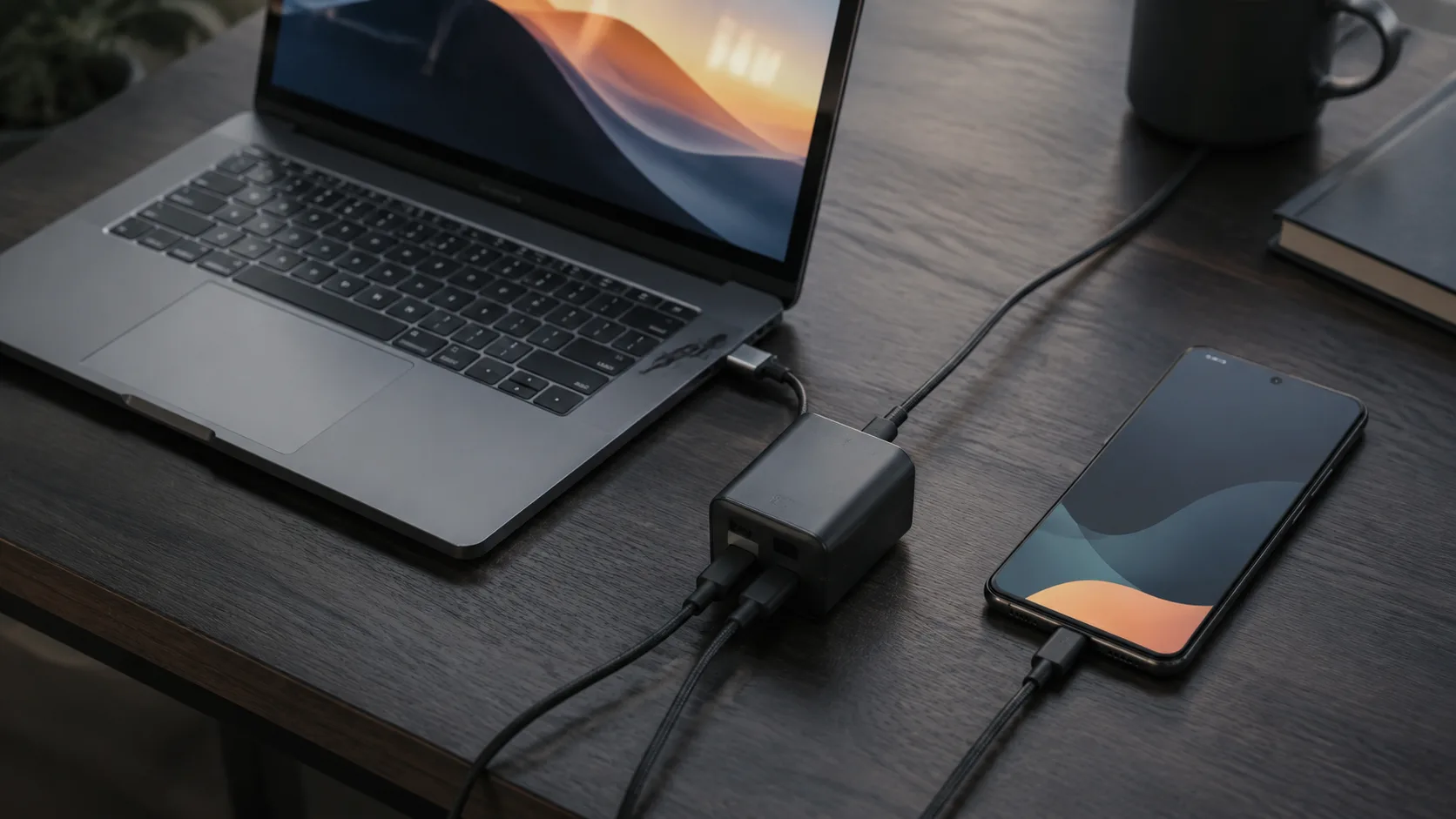
Can You Use a Laptop USB-C Charger With an Android Phone?
A laptop USB-C wall charger and the laptop USB-C port are different supplies. Compare Dell's 15 W port ceiling, Lenovo 20 V input, PPS, and the 60 W cable logo.
Read article
USB PD vs. PPS: The Android Charging Difference That Matters
PPS is optional inside USB PD 3.0. The phone requests a voltage in 20 mV steps. A 60W or 240W mark is a cable logo.
Read article
What Is a GaN Charger and Does It Work With Android?
GaN is the semiconductor in the adapter. PPS is a USB PD 3.0 feature. A 60 W or 240 W mark on a USB-C cable is a cable logo, not the charger rating.
Read article